The Psychology of Requesting Leave in High-Pressure Roles
In high-stress work environments—think investment banking, healthcare, software engineering during a sprint, or high-level crisis management—the "perfect time" to take leave simply does not exist. There is always another deadline, another client emergency, or another critical project on the horizon. Because of this, many professionals experience "leave guilt," a psychological barrier that prevents them from taking the rest they’ve earned.
However, the irony of high-stress environments is that the more critical the work, the more essential the rest. Burnout doesn't just hurt you; it creates cognitive friction that leads to mistakes, impacting the very projects you are trying to protect. Writing a formal email to your boss for leave in these settings requires more than just stating dates; it requires a demonstration of competence and a plan for continuity.
Key Components of a High-Stress Leave Request
Before we dive into the templates, you need to understand the structural pillars of a successful request. In a fast-paced office, your manager's primary concern isn't your absence—it's the gap left behind. Your email must address these concerns proactively to make the "Yes" as easy as possible.
Advance Notice
The more stressful the environment, the more lead time is required. Aim for 2-4 weeks minimum for short breaks, and months for extended leave.
Coverage Plan
Never leave your boss wondering who will handle the fire drills. Explicitly state who is covering which tasks.
The "Hard Stop"
Clearly define your level of availability. In high-stress roles, being "partially available" often leads to working your entire vacation.
Status Update
Briefly mention that current tasks are on track so your absence doesn't look like an escape from a mess.
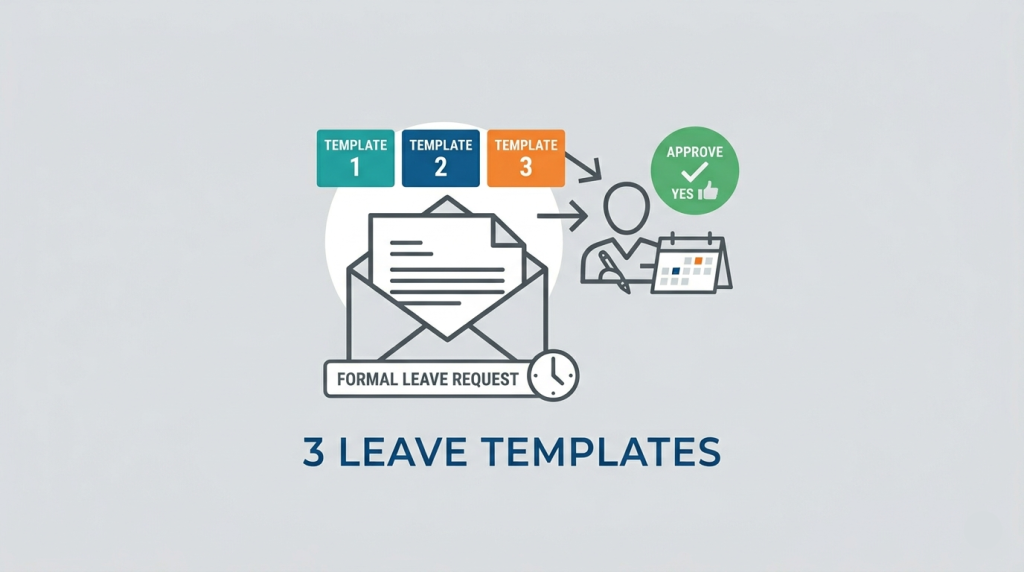
Template 1: The "Proactive Planner" (Best for General Leave)
This template is ideal for when you are requesting time off well in advance. It focuses on the "Business Continuity" aspect, showing your boss that you are thinking about the team's success even while you are away.
Subject: Leave Request - [Your Name] - [Dates]
Dear [Boss's Name],
I would like to request a formal leave of absence from [Start Date] to [End Date], returning to the office on [Return Date].
In preparation for this time off, I have already ensured that the [Project Name] milestones will be met ahead of schedule. [Colleague's Name] has kindly agreed to be the point of contact for any urgent matters regarding [Task/Account] during my absence. I will provide a full handover document by [Date] to ensure a seamless transition.
My goal is to ensure that my absence has zero impact on our current Q3 momentum. Please let me know if this timeframe works for the team, or if you would like to discuss the coverage plan further.
Best regards,
[Your Name]
Why this works:
- Assurance of Progress: Mentioning milestones are "ahead of schedule" settles anxiety.
- Peer-to-Peer Solutions: You aren't asking the boss to find a replacement; you’ve already done it.
- Ownership: The mention of a "handover document" shows high professional maturity.
Template 2: The "Strategic Recharge" (Best for Burnout Prevention)
High-stress environments often lead to diminishing returns on productivity. If you are feeling the weight of burnout, it is better to take a short, strategic break than to crash. This template frames the leave as an investment in future performance.
Subject: Leave Request: Strategic Time Off - [Your Name]
Hi [Boss's Name],
Following the successful delivery of [Recent Big Project], I would like to schedule a week of leave from [Date] to [Date].
Given the intensive pace of the last few months, I want to take this window of time to recharge so I can return fully focused for the upcoming [Next Big Project/Busy Season]. I’ve verified the team calendar and noticed this is a relatively quiet period before [Date].
I will ensure all my current deliverables are up to date before I head out. I do not anticipate any roadblocks during this week, but [Colleague's Name] will be available for emergency support.
Thank you for your support in maintaining a high level of team performance.
Best,
[Your Name]
Why this works:
It utilizes the "Window of Opportunity" logic. By pointing out that it is a "quiet period," you are demonstrating that you are aware of the business cycle. It frames the leave as a way to maintain a "high level of team performance," which aligns your personal needs with the company's goals.
Template 3: The "Urgent/Family Matters" (Best for Short Notice)
Sometimes, life happens. In a high-stress environment, short-notice requests can be particularly tense. This template focuses on brevity and the absolute nature of the request while remaining deeply professional.
Subject: Urgent Leave Request - [Your Name] - [Dates]
Dear [Boss's Name],
Due to unexpected personal family matters that require my immediate attention, I am writing to request leave starting [Date] through [Date].
I understand this is short notice, particularly given our work on [Current Task]. To minimize the impact, I have already [Action Taken, e.g., updated the project tracker / briefed the team / automated X report]. I have also BCC’d [Colleague] here so they are aware of my absence for the remainder of the week.
I plan to be back at my desk on [Return Date] and will work diligently to catch up on any pending items immediately upon my return. Thank you for your understanding and flexibility during this time.
Sincerely,
[Your Name]
Handling the "Always-On" Expectation
One of the biggest hurdles in a high-stress work environment is the unspoken expectation that you are available 24/7. When you send your formal email to your boss for leave, you must be clear about your boundaries.
The Three Levels of Availability
-
OFF-GRID
You will not be checking email. Use this for major burnout or true vacations. Ensure your coverage plan is bulletproof.
-
EMERGENCY ONLY
You can be reached via text/phone for "house on fire" situations only. Define what an emergency is (e.g., server down, client churn).
-
LIGHT CHECK-IN
You check email once a day. This is generally discouraged in high-stress roles as it prevents true recovery, but it can be a necessary compromise for some leaders.
The Importance of the "Pre-Leave" Meeting
In the most intense environments, an email alone might feel cold or sudden. A common best practice is to have a 5-minute verbal "heads up" with your boss before hitting send on the formal request.
You might say: "Hey [Boss], I’m looking at the calendar for next month and I’m planning to take a week off to recharge before the fall rush. I’ve already worked out a coverage plan with Sarah, so I’ll send over the formal email with the details shortly."
This approach removes the "shock" factor and allows your boss to voice any immediate concerns that you can then address in the formal email body. It turns a "request" into a "shared plan," which is the hallmark of a high-functioning professional relationship.
Final Thoughts on Professionalism
Remember, leave is part of your total compensation package. It is not a gift; it is a contractual right. However, in the high-stakes world of modern business, how you claim that right determines your path to promotion and leadership. By using these templates and following a continuity-first mindset, you prove that you are not just a hard worker, but a strategic asset who knows how to manage their most important resource: themselves.